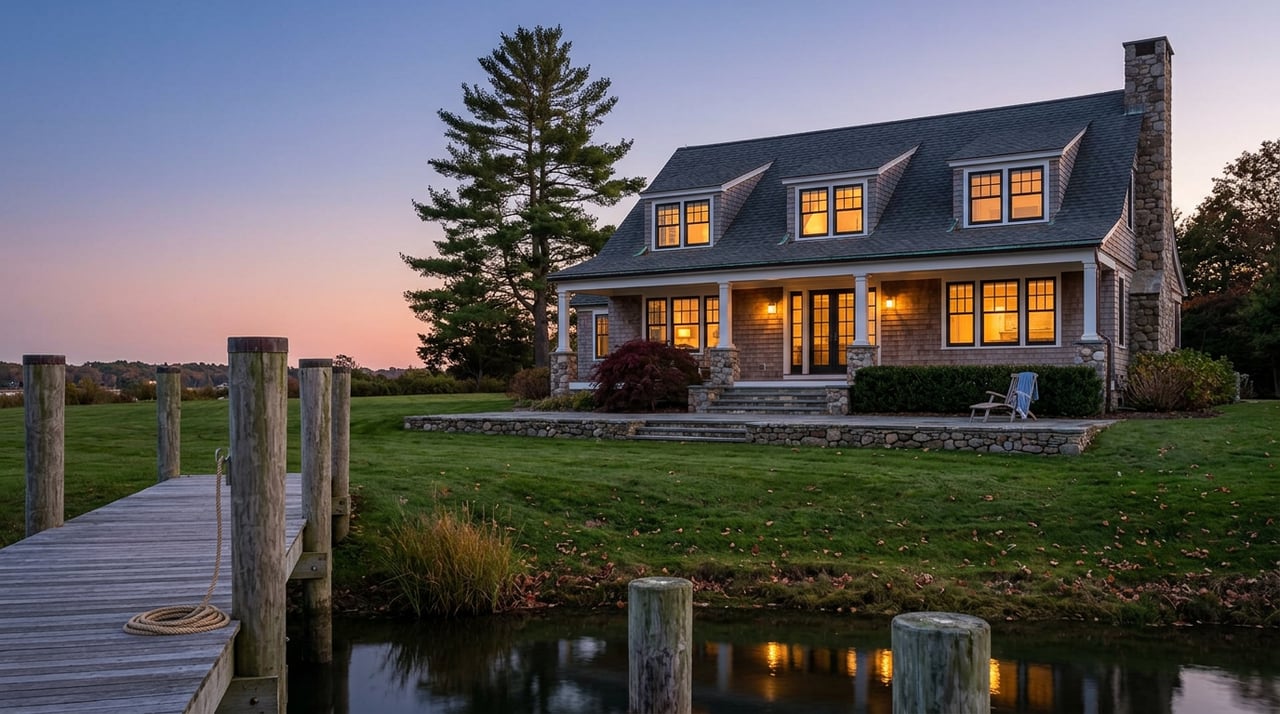
Picture a Rumson waterfront listing priced at $3.2 million, right around where the town's own median has been sitting most of this year. Two summers ago, closing that sale meant the seller paid the standard state transfer fee, as Friscia Law explains. Saul Ewing describes New Jersey's so-called mansion tax then as a flat 1 percent paid by the buyer, and that was the extent of it.
Sell that same house today and the math looks nothing like it did in 2024. The mansion tax now belongs entirely to the seller. It is no longer flat. And at $3.2 million, the Cape May County Clerk's Office schedule puts the rate at 3 percent; Luxury Price Drops explains that it is charged against the full price rather than the amount above any threshold. That single shift adds roughly $96,000 to the seller's side of the ledger, on top of the standard transfer fee that was always theirs to pay. For a town where a meaningful share of active inventory sits at or above that price point, this isn't a footnote. It's a number every seller needs in hand before a sign goes in the yard.
What Changed, and Why It Still Catches People Off Guard
New Jersey's legislature rewrote the rules on the supplemental Realty Transfer Fee, commonly called the mansion tax, in a budget bill Governor Murphy signed on June 30, 2025. The new structure took effect for contracts executed on or after July 10, 2025. Two things moved at once. First, the obligation to pay flipped from buyer to seller. Second, the flat 1 percent rate became a graduated schedule that climbs as the sale price climbs, topping out at 3.5 percent.
A grace period softened the landing for deals already in motion. Contracts signed before July 10, 2025 that recorded a deed by November 15, 2025 could still use the old 1 percent rate, with sellers eligible to file for a refund if they had already paid more. That window closed roughly ten months ago. Anyone listing a Rumson property today, whether it's a classic Cedar Shake Colonial off Ridge Road or a Navesink River estate with a private dock, is working entirely under the new rules. There is no version of this transaction where the old flat fee applies anymore.
The other detail that trips people up: the rate isn't marginal. New Jersey applies the tier percentage to the entire sale price, not just the portion that exceeds the threshold. That single design choice is responsible for most of the sticker shock sellers describe when they finally see a real net sheet.
The Tiers, Priced for Rumson
Here's the schedule as it stands, paired with what it actually costs at price points that show up regularly in Rumson's market. Each row combines the new graduated fee with New Jersey's standard Realty Transfer Fee, which stacks on top of the new tax rather than replacing it.
| Sale price | Graduated Percent Fee (seller) | Standard Realty Transfer Fee (approx.) | Combined state transfer cost |
|---|---|---|---|
| $1.8 million | 1% = $18,000 | ≈1.2% = $21,780 | ≈ $39,780 (2.2% of price) |
| $2.75 million | Wasserman Accounting: 2.5% = $68,750 | ≈1.2% = $33,275 | ≈ $102,025 (3.7% of price) |
| $3.2 million | 3% = $96,000 | ≈1.2% = $38,720 | ≈ $134,720 (4.2% of price) |
| $5 million | 3.5% = $175,000 | ≈1.2% = $60,500 | ≈ $235,500 (4.7% of price) |
The standard fee figures are approximate, since New Jersey's transfer fee schedule has smaller brackets at lower price bands that flatten toward roughly 1.2 percent once a sale climbs into the millions. Any seller working through actual numbers should confirm the exact figure with their closing attorney, but the pattern holds regardless: the higher the price, the more disproportionately the graduated tier eats into proceeds, because the full price gets taxed at the higher rate rather than just the top slice.
Why Rumson Sits Right in the Middle of This
Rumson's own pricing puts a large share of its market inside the tax schedule's steepest tiers, not its gentlest ones. Recent tracking of the town's list prices has shown a median hovering between $3.07 million and $3.22 million over the past several months, meaning a typical current listing already sits inside the 3 percent bracket before a single offer comes in. Waterfront inventory runs higher still. As of mid-August 2026, waterfront listings in Rumson carried a median asking price around $3.32 million, squarely in that same top-tier territory.
Homes.com data reported in April 2026 put the preceding 12 months at roughly 106 Rumson sales with an average price near $3.1 million, which tracks with the town's reputation as a market where transactions cluster well above the $2 million line where the graduated schedule starts to bite. At the very top of the range, Rumson's benchmark sale has been Long Point Estate, an 18,000 square foot waterfront property that sold for $12 million, and as of August 2026 the town had a five-acre compound at 100 West River Road on the market at $26 million, spanning four separate residences along the Navesink. Under the pre-2025 rules, a $26 million sale would have handed the buyer a flat $260,000 obligation. Under the current schedule, that cost belongs to the seller, and at 3.5 percent of the full price, it runs closer to $910,000 before the standard transfer fee is even added.
The point isn't that every Rumson seller is moving eight-figure estates. It's that the town's price center of gravity, not just its outliers, sits inside the bracket where this tax now does the most damage, and where the identity of who pays it changed most recently.
The Dollar That Can Cost You $20,000
Because the rate applies to the whole price rather than the amount above a threshold, the boundaries between tiers create real cliffs. A sale that closes at exactly $2,000,000 is taxed at 1 percent, or $20,000. A sale that closes one dollar higher, at $2,000,001, jumps to the 2 percent tier applied against the full amount, pushing the fee to roughly $40,000. That's a $20,000 swing triggered by a single dollar of negotiated price.
This matters in a market like Rumson's, where escalation clauses and multiple-offer situations are common enough that a final number can drift past a round threshold without anyone pausing to check what that drift costs on the seller's side of the closing statement. A listing price set at $2,495,000 to leave room for negotiation, for instance, sits comfortably in the 2 percent tier. A final accepted offer of $2,505,000 lands in the 2.5 percent tier instead, adding meaningfully more than the extra $10,000 in sale price would suggest. The same cliff repeats at $2.5 million, $3 million, and $3.5 million.
What This Means If You're Listing This Fall
A few practical habits are worth building into any Rumson listing conversation from the start:
- Ask for a real net sheet before you set a list price, one that reflects the graduated fee as it applies today, not a template built before July 2025.
- If your target price sits within a few thousand dollars of a tier boundary, talk through the tradeoffs with your attorney before you accept an offer, not after.
- Remember that the fee is a statutory seller obligation, but buyer and seller remain free to negotiate who effectively absorbs the cost in the contract terms. That's a conversation worth having early, particularly in a negotiation where a buyer's escalation pushes the price across a threshold.
- Don't assume an old closing cost estimate, from your last Rumson sale or from a generic online calculator, still reflects current law. The rules changed once already in the past year and a half, and the difference between old and new is not small.
None of this is a reason to delay a sale. It's a reason to walk in with accurate numbers rather than numbers that were accurate eighteen months ago.
A Few Straight Answers
Does this apply to every home sale in Rumson? Only sales priced above $1 million trigger the graduated fee at all. Below that threshold, a seller owes the standard Realty Transfer Fee and nothing more. Given where Rumson's market sits, most transactions here clear that line, but it's a relevant distinction for smaller condos or starter properties in town.
Can I negotiate for the buyer to cover part of it? The statute places legal responsibility on the seller, but nothing prevents buyer and seller from privately agreeing to a different allocation in the contract. It's a negotiation point, not an automatic option, and it should be documented clearly by your attorney.
Is this the same thing as the standard Realty Transfer Fee? No. The standard fee has applied to New Jersey sellers since 1968 and is separate from the graduated fee. Both apply on a sale above $1 million, and they're added together, not substituted for one another.
Numbers like these are exactly why a net sheet matters more than a listing price. If you're weighing a sale in Rumson this fall, whether it's a longtime family home on the Navesink or a first move into the waterfront market, Jacqueline Mazzucco can walk through what the current tax structure actually means for your specific price point before you commit to a number. Let's Connect.
This article is general information, not legal, tax or financial advice. Consult a qualified professional about your situation.